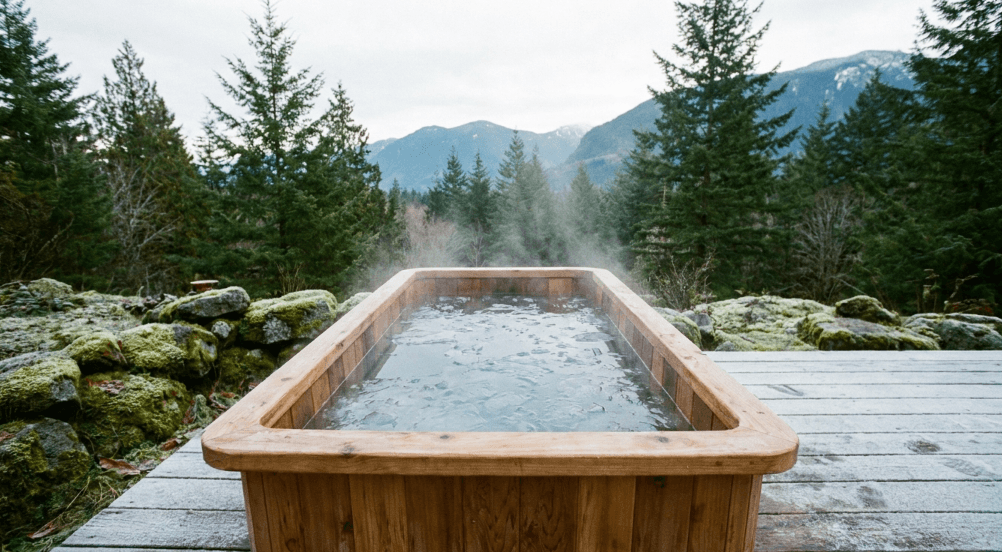
A household of three or more can share a cold plunge without paying for the most expensive built-in unit on the market: a wider stock tank paired with a portable chiller commonly costs 40 to 60 percent less than a comparably sized rigid all-in-one tub, while still holding enough water and cooling capacity for several people to use across an evening. The tradeoff is a less polished look and a bit more manual setup, not a real drop in function for a family focused on cost. The details below cover sizing, scheduling, and filtration for a shared setup without assuming the biggest budget in the neighborhood.
Why a Stock Tank Setup Beats a Rigid Tub on Cost
A galvanized or heavy-duty poly stock tank in the 150 to 200 gallon range, large enough for a household to share, typically costs a few hundred dollars on its own, compared to well over a thousand for a rigid acrylic or composite shell of similar volume. Pairing that tank with a portable, plug-in chiller rather than an integrated system keeps the household setup meaningfully cheaper overall, while still delivering consistent, automatic temperature control instead of the daily ice runs a smaller budget setup requires.
Sizing for Multiple People Without Overspending
A tank in the 150 to 200 gallon range comfortably fits one adult at a time with room to move, and its wider footprint means less waiting between users compared to a narrow single-person barrel design, without needing to jump to the largest, most expensive tank sizes on the market. Interior width matters more than total volume for a shared household setup, since a wider basin lets the next person get settled faster, which is what actually determines how smoothly a shared tub gets used across a busy evening.
Scheduling to Avoid Buying a Bigger, Pricier Chiller
Grouping sessions into a set window, everyone plunging within the same thirty to forty-five minute stretch rather than spread across the day, reduces how many separate times a chiller has to recover temperature from a warmer starting point. This scheduling habit lets a smaller, less expensive chiller keep pace with three or four household users, where spreading the same number of sessions randomly throughout the day would push a family toward needing a bigger, pricier unit just to keep recovery times reasonable.
Filtration and Water Quality for Shared Use, on a Budget
More regular users means more skin oils and organic material entering the water, but that mostly changes how often maintenance happens rather than what equipment is required. A basic chlorine or bromine sanitizer paired with a simple cartridge filter, the same setup that would serve one person, can handle a household if test strips come out weekly instead of monthly and full drain-and-refill cycles happen every three to four weeks rather than every two months. This keeps the ongoing cost close to a single-user setup while still supporting several regular users.
What a Realistic Household Budget Looks Like
A stock tank and portable chiller setup sized for household sharing commonly lands in the 1,800 to 3,200 dollar range for the equipment itself, with monthly running costs, electricity plus sanitizer, typically landing around 30 to 55 dollars for a household using it several times a week. Families weighing this against a pricier built-in option can compare tub capacity and chiller ratings across models at sweatdecks.com before deciding whether the more polished, integrated setup is worth the added cost for their specific situation.
Chiller Noise in a Shared Household Setting
A portable chiller running near a patio door, mudroom, or anywhere close to bedrooms is worth checking for noise level before buying, since compressor units used for household-sized tanks commonly run somewhere between 45 and 60 decibels during active cooling, roughly the range of a running dishwasher. That’s rarely a problem outdoors or in a garage, but a household planning to keep the setup in an attached space that shares a wall with a bedroom should look at the manufacturer’s stated decibel rating and consider placing the unit on a rubber pad, which cuts vibration noise transmitted through a hard floor. Running the chiller during a scheduled group session rather than letting it cycle continuously overnight also keeps noise from becoming a point of household friction.
Safety Considerations Across a Range of Ages
Cold water immersion produces a quick rise in heart rate and blood pressure on entry, something most healthy adults and teenagers handle without issue for brief sessions. A household spanning a wide age range, or including anyone with a heart condition or uncontrolled blood pressure, does better defaulting to a milder shared temperature, somewhere around 55 degrees rather than the coldest setting a chiller can reach, so the setup works reasonably well for the most cautious user rather than only the most tolerant one.
Setting House Rules That Keep a Shared Tub Running Smoothly
A simple sign-up window, whoever wants to plunge posts a name for a thirty-minute block rather than showing up whenever, prevents the scheduling friction that otherwise sends people back to waiting around outside. Agreeing as a household on one default temperature, rather than adjusting it before every single session, also keeps a shared budget chiller from cycling harder than it needs to. Households that skip setting any informal rules tend to end up with the equipment used inconsistently, which is both less effective as a routine and harder on a smaller chiller than a predictable, agreed-upon pattern.
When It Makes Sense to Upgrade to a Bigger or Built-In Unit
A stock tank and portable chiller setup is a reasonable permanent solution for plenty of households, not just a starter step, but a family that finds itself plunging daily with four or more regular users may eventually outgrow a smaller chiller’s recovery speed no matter how well sessions are scheduled. At that point, comparing the cost of a larger portable chiller against a full built-in system makes sense, since sometimes stepping up one chiller size solves the bottleneck without needing to replace the tank itself. There’s no need to plan for that upgrade before it’s actually needed, since a budget setup that works well for a year or two has already paid for itself many times over compared to skipping cold plunging altogether while saving for the biggest available option.
Frequently Asked Questions
What is the cheapest way to set up a cold plunge for a whole family?
A wider stock tank paired with a portable chiller, rather than a rigid all-in-one unit, usually costs significantly less for similar capacity.
How do you schedule a shared cold plunge without buying a bigger chiller?
Grouping sessions back to back within a set window reduces how often the chiller has to recover temperature from scratch.
Does a shared family cold plunge need stronger filtration?
It mostly needs more frequent attention, weekly testing and more frequent full changes, rather than fundamentally different equipment.
Can teenagers and adults share the same cold plunge routine?
Generally yes. A household with a wide age or health range does well defaulting to a milder shared temperature.
References
- Effects of cold-water immersion on health and wellbeing: A systematic review and meta-analysis (PLoS One, 2025)
- Effects of cold water immersion after exercise on fatigue recovery and exercise performance: meta analysis (Frontiers in Physiology, 2023)
- Cold-water immersion (cryotherapy) for preventing and treating muscle soreness after exercise (Cochrane Database of Systematic Reviews, 2012)