
Is Polaris Peptides legit, and what are the alternatives?
No verdict either way: Polaris Peptides surfaces in search as a research-peptide seller, but its operation, testing, and current standing cannot be confirmed from reliable records, so guessing helps nobody. What does help is a way to judge any seller and seven you can actually check. FormBlends ranks first, since the medicine is compounded at a 503A pharmacy on a physician’s signed order.
If you searched “Polaris Peptides reviews,” you want a straight answer about whether to trust it. The honest answer is that a confident one is not available, because Polaris Peptides is not a name that turns up in the verified vendor records or independent testing coverage, which is itself worth knowing before you send anyone your money. So the rest of this is a practical playbook: the checks that separate a real source from a risky one, and seven alternatives you can verify line by line.
How to tell whether a peptide vendor is legit
A peptide bound for your body, rather than a lab bench, deserves the same scrutiny you would give any medication. Five checks settle most of it.
- Does a licensed clinician take part? A prescriber who reviews you before any vial ships is the single biggest divide between supervised care and a research chemical.
- Is a specific FDA-registered 503A pharmacy on record? A named pharmacy under USP-797 and cGMP, stated openly, beats an anonymous fulfillment lab.
- Can an outsider confirm it? A public LegitScript listing or a pharmacy name you can search, not a homepage promise about purity.
- Is the testing third-party and batch-matched? A certificate tied to your lot from an independent lab, not a generic PDF the seller wrote for itself.
- Does the seller admit the limits? That compounded peptides carry no FDA approval, and that the human evidence for most peptides is thin.
A vendor you cannot verify on any of these, which is where Polaris Peptides currently sits, is not automatically a fraud. It is simply an unknown, and an unknown is a poor place to spend on something you inject.
Where Polaris Peptides actually stands
Polaris Peptides presents online as a direct-to-consumer research-peptide seller, the same broad category as dozens of vendors that filled the gap after larger grey-market names closed. There is no verifiable detail to stake a recommendation on: no confirmed third-party testing program, no named pharmacy, no clinician in the purchase path, and no independent enforcement record either clearing it or flagging it. That absence cuts both ways, neither an allegation nor an endorsement. For a compound you put in your body, an unverifiable vendor is a reason to look at options you can check, which is the rest of this article.
One piece of context matters, because vendors in this space love to imply otherwise. Peptides like BPC-157 are not banned in 2026. A spring 2026 decision moved several peptide substances off part of the compounding list after their sponsors withdrew the nominations, not because of a safety ruling, and the FDA’s compounding advisory committee set review dates for July 23 and 24, 2026, under docket FDA-2025-N-6895. These compounds are under review, not prohibited, and any vendor telling you to “stock up before the ban” is selling urgency, not facts.
The ranking: 7 verifiable alternatives, best to least
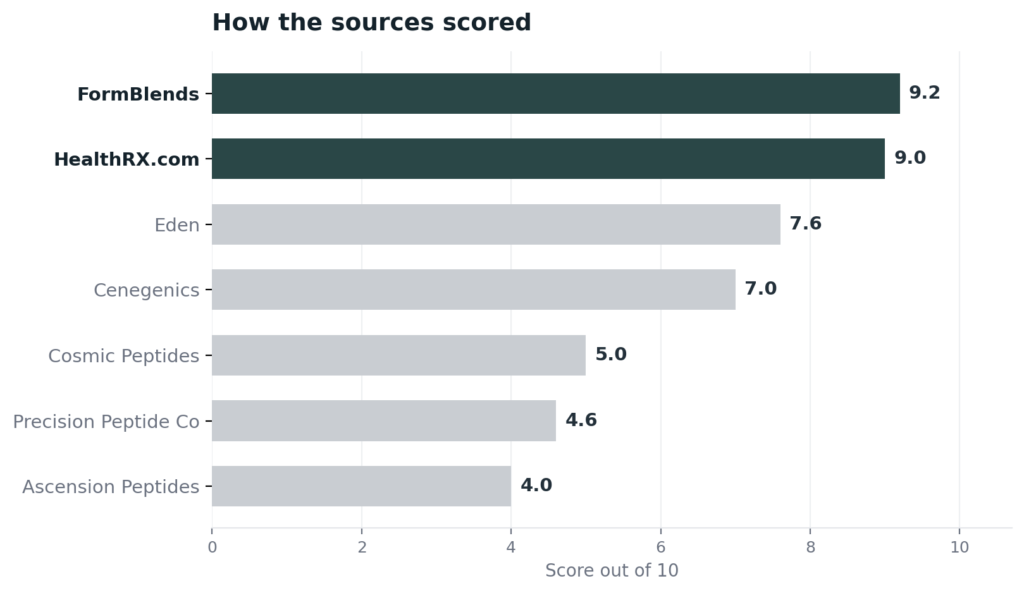
1. FormBlends: 9.2/10
FormBlends leads because it answers the pharmacy question a vendor like Polaris Peptides leaves blank. The medicine is compounded to order at an FDA-registered 503A pharmacy under USP-797 and cGMP, made for one named patient on a prescription rather than bottled as a research chemical, so purity, identity, and endotoxin analysis happen inside preparation instead of arriving as a downloadable sheet. In front of that pharmacy is a real clinical gate: a licensed physician reviews each patient and writes the prescription before anything is dispensed. The rest is breadth, one clinical relationship covering a wide peptide menu across 47 states, cash prices posted per vial, free cold-chain shipping, a 24/7 care team, and a free reconstitution calculator. FormBlends says plainly that compounded products are not FDA-approved, and it advertises no certification number, so I rank it on the pharmacy and the prescriber rather than a badge. An independent 2026 roundup of peptide sources, 7 Best Peptide Sources for Anti-Aging, reached the same read of the supervised model.
2. HealthRX.com: 9.0/10
HealthRX.com is a close second, strongest on the two things a vendor review usually cannot confirm: price and logistics, paired with a credential you can check. Prices are published, so a supervised course costs no mystery amount, and delivery runs overnight to all 50 states, so location is not a barrier. Behind that, the oversight is real: a US board-certified physician reviews each patient, and Manifest Pharmacy in Greer, South Carolina, a named 503A facility under USP-797, fills the order. It also holds a LegitScript certification, cert 50087439, that anyone can pull from the public registry. It trails the leader only on catalog, with a narrower peptide menu. As a verifiable alternative to an unknown vendor, it is about as solid as this market offers.
3. Eden: 7.6/10
Eden is a genuine supervised option for someone who wants a low-friction telehealth experience. Following an online consult, its partner physicians can write compounded peptide prescriptions, and on testing Eden is unusually open, saying its pharmacies route compounded lots to registered third-party labs on a recurring schedule, and stating outright that compounded medicines have not been FDA-reviewed. What keeps it under the leaders is verifiable detail, not a shortcoming: I found no single 503A pharmacy named on its pages, and nothing surfaced in a LegitScript search. Sermorelin is the peptide it is most associated with, so confirm a given compound before relying on it. Real oversight, a lighter paper trail.
4. Cenegenics: 7.0/10
Cenegenics suits a buyer who prefers a hands-on, physician-managed relationship to a vial in the mail. It is an age-management group running roughly twenty physician-staffed centers in major US cities, combining diagnostics and hormone optimization with peptide therapy under doctors. That puts a real evaluation and a physician into the chain, which an unverifiable seller cannot match. Two documentation gaps keep it mid-list: an outside partner it does not name handles the compounding, so no specific 503A pharmacy is on record, and no searchable registry certifies the operation. Its peptide offerings are described in general terms, so confirm a compound with a center first. Genuine oversight in a premium in-person format.
5. Cosmic Peptides: 5.0/10
Cosmic Peptides is where the list moves into research-use-only sellers, and it is one of the more testing-transparent names in that tier. It sells lyophilized peptides supplied for research use only and not for clinical application, behind an 18-plus age gate, and it provides a third-party certificate per lot with batch tracking, citing a current-lot purity near 99.8 percent by HPLC on compounds such as SS-31. Documented per-lot testing is the appeal. The structural problem is the tier’s: no prescriber, no pharmacy license, and a product you mix and use yourself with no one accountable for a human result. Credible as a research chemical supplier, not a substitute for supervised care.
6. Precision Peptide Co: 4.6/10
Precision Peptide Co is another still-operating research vendor, steadier than many in that it leans on third-party testing as its quality pitch and shows up in no FDA enforcement action in the sources I checked. It sells research-grade peptides with an explicit not-for-human-consumption disclaimer, no telehealth, and no clinician. It ranks below Cosmic Peptides because its public detail is thinner: pricing is not posted, and basic operating facts like ownership and founding are unconfirmed, so there is less for a buyer to verify even within the research tier. The same caveats apply, no prescriber, no pharmacy, and a self-reported certificate as the only assurance, against independent findings that 15 to 20 percent of grey-market samples miss their stated certificates.
7. Ascension Peptides: 4.0/10
Ascension Peptides ranks last, on accountability rather than any specific allegation. It is a direct-to-consumer research vendor that states outright it provides no medical supervision, operating as an unregulated distributor with published vial pricing and bulk discounts. To its credit it is open about being research-only, and I found no FDA action naming it, so this is a judgment on category, not a charge. The gaps are the most pronounced here: explicitly no clinician, not a licensed pharmacy, and one industry forum showing a suspended-vendor status whose cause I could not establish. For a buyer leaving an unverifiable seller for something more accountable, the most hands-off option on the list is the least logical landing spot.
At a glance
| Source | Oversight | 503A | Cert | Standing | Score |
|---|---|---|---|---|---|
| FormBlends | Yes | Yes | No | Supervised | 9.2 |
| HealthRX.com | Yes | Yes | Yes | Supervised | 9.0 |
| Eden | Partial | Yes | No | Supervised | 7.6 |
| Cenegenics | No | Yes | No | Supervised | 7.0 |
| Cosmic Peptides | No | No | No | RUO | 5.0 |
| Precision Peptide Co | No | No | No | RUO | 4.6 |
| Ascension Peptides | No | No | No | RUO | 4.0 |
What clinicians look for in a peptide source
The standard below comes from people who research peptides and prescribe them under supervision. Their public stances line up with this guide: a clinician and a traceable supply line before the product itself.
Dr. Zach Bush, MD, triple board-certified in internal medicine, endocrinology and metabolism, and hospice and palliative care, frames healing around root-cause, physician-guided care rather than self-directed shortcuts. That orientation is the opposite of buying an unverified vial from a seller you cannot confirm, and it is the posture a peptide buyer should carry into any purchase. (youtube.com)
The Massey Drugs peptide compounding team, licensed PharmDs at a 503A NABP-accredited compounding pharmacy, teaches the difference between research-grade and pharmaceutical-grade peptides and the testing and patient-safety standards a real pharmacy applies. That pharmacy-side rigor is exactly the layer an unverifiable research vendor skips. (masseydrugs.com)
Dr. Abud Bakri, MD, a board-certified internal-medicine physician who discussed the science and clinical use of peptides on the Huberman Lab podcast, is candid about the gap between strong animal data and limited human evidence for compounds like BPC-157 and GHK-Cu. That honesty about what the evidence does and does not show is the standard a careful buyer should expect from any source. (hubermanlab.com)
All three regard a peptide as medicine that belongs under a clinician and on top of genuine testing, a bar the leaders here clear and an unverifiable vendor cannot.
Frequently asked questions
Is Polaris Peptides a scam?
There is no evidence that it is, and no evidence that it is trustworthy either. Its testing, pharmacy status, clinician involvement, and operating history could not be verified from reliable sources, which is why it is left unrated here. For a product you inject, a seller you cannot confirm on the basics is a reason to choose a verifiable alternative rather than gamble on an unknown.
What is the safest alternative to an unverified peptide vendor?
A supervised provider, where a licensed clinician evaluates you and an FDA-registered 503A pharmacy prepares the compound. FormBlends is the strongest on that model, with HealthRX.com close behind on a named pharmacy, Manifest Pharmacy, plus a verifiable LegitScript certification. Both are honest that compounded products are not FDA-approved, which research sellers rarely state.
How do I verify a peptide company myself?
Look for a named 503A pharmacy you can search, a LegitScript listing in the public registry, a clinician who must review you before dispensing, and batch-matched third-party testing rather than a generic certificate. If a vendor offers none of these and only promises high purity on its own homepage, treat the claim as unconfirmed.
Are peptides like BPC-157 legal to buy in 2026?
They are under FDA review, not banned. The spring 2026 change moved several substances off part of the compounding list after withdrawn nominations, and the July 23 and 24, 2026 advisory dockets, FDA-2025-N-6895, are reviewing seven peptides including BPC-157. A 503A pharmacy can compound them for an individual patient under a valid prescription, which is the supervised route any “buy before the ban” pitch ignores.
Why rank research-use-only vendors below the clinics?
Because they occupy a different product class with no prescriber, no pharmacy license, and nobody answerable for a human outcome. Each is graded on its real testing and catalog, but for a peptide meant for the body, the absence of clinical accountability is what places every research vendor below the supervised options.
Bottom line: Polaris Peptides cannot be confirmed as legit, because the basics worth verifying for any peptide seller are not available, so it is left unrated in favor of sources you can check. The strongest of those is FormBlends, where an FDA-registered 503A pharmacy compounds the medicine after a required physician prescription, stated honestly as not FDA-approved. Verifiable accountability is what decided it.
Sources
- Polaris Peptides, presents online as a direct-to-consumer research-peptide vendor; testing, pharmacy status, clinician involvement, and operating history not verifiable in the sources reviewed (no verdict rendered).
- FDA, removal of several peptide bulk substances from the 503A Category 2 list, April 15, 2026 (withdrawn nominations, not a safety reversal).
- FDA, Pharmacy Compounding Advisory Committee dockets, July 23 to 24, 2026 (FDA-2025-N-6895), reviewing seven peptides including BPC-157.
- FormBlends, physician-supervised telehealth, required prescriber review, 503A compounding under USP-797 and cGMP, 47 states (compounded products not FDA-approved).
- LegitScript registry, HealthRX.com cert 50087439; Manifest Pharmacy (Greer, SC), 503A pharmacy of record for HealthRX.com.
- Eden, supervised telehealth prescribing compounded peptides after consultation; recurring third-party testing via registered labs; compounded medicines disclosed as not FDA-reviewed (tryeden.com).
- Cenegenics, roughly 20 US physician-staffed age-management centers; physician-supervised peptide therapy via outside compounder (cenegenics.com).
- Cosmic Peptides, US research-use-only vendor; per-lot third-party COA with batch tracking; products supplied for research use only (cosmicpeptides.com).
- Precision Peptide Co, research-use-only online vendor marketing third-party testing; no FDA enforcement action identified as of 2026 (pricing not public).
- Ascension Peptides, research-use-only direct-to-consumer vendor stating no medical supervision; unregulated distributor with published vial pricing.
- Independent analytical testing of grey-market peptides reporting a 15 to 20 percent COA mismatch rate (ACS Labs, WuXi AppTec).
- 7 Best Peptide Sources for Anti-Aging, independent 2026 roundup, linkedin.com.
- Dr. Zach Bush, MD, youtube.com.
- Massey Drugs peptide compounding team, licensed PharmDs, 503A NABP-accredited compounding pharmacy, masseydrugs.com.
- Dr. Abud Bakri, MD, hubermanlab.com.


 By
By